Prepared by the Crosste product team. We manufacture EVA martial arts mats for dojos, clubs and distributors, with product options reviewed against your project requirements.
For many karate training rooms, interlocking EVA tiles in 100 × 100 cm formats are a practical starting point. Selection should consider footwork, impact activities, thickness, density and the available grade combinations. Where training includes sweeps or falls, review the expected impact, substrate and available test data before selecting a thicker mat. Thickness alone does not establish fall protection. Compare thickness, available density, tile dimensions, surface texture and interlocking-edge design. For a performance-critical project, request model-specific test data and a physical sample. Three numbers decide how a mat behaves: thickness, density, tile size.
What Is the Point of Tatami Mats?
Tatami mats give practitioners a firm, uniform, defined surface for barefoot training. Traditionally they are a woven rush-straw covering over a dense core, laid as flooring in Japanese rooms and dojo. Today the word usually describes the look and texture of a training mat, not woven straw.
Where tatami comes from
In Japanese buildings, tatami is a floor, not an accessory. It is quiet underfoot, consistent from one mat to the next, and it marks out a clear practice area. Traditional tatami are rectangular, roughly twice as long as they are wide, and rooms were laid out around that module. Dojo adopted tatami because the same qualities suit training: stable footing, a surface you can bow and kneel on, and no gaps or edges to catch a foot.
What modern tatami-style mats are
In martial arts flooring, tatami-style usually describes an embossed surface pattern. Grip depends on the surface design, material and conditions of use; ask for a sample to assess footwork and cleaning.
Tatami mat vs karate mat
Karate interlocking EVA tiles and judo tatami use different constructions. Compare the relevant product datasheets and impact requirements rather than judging suitability from foam density alone.
What a Karate Floor Actually Has to Do
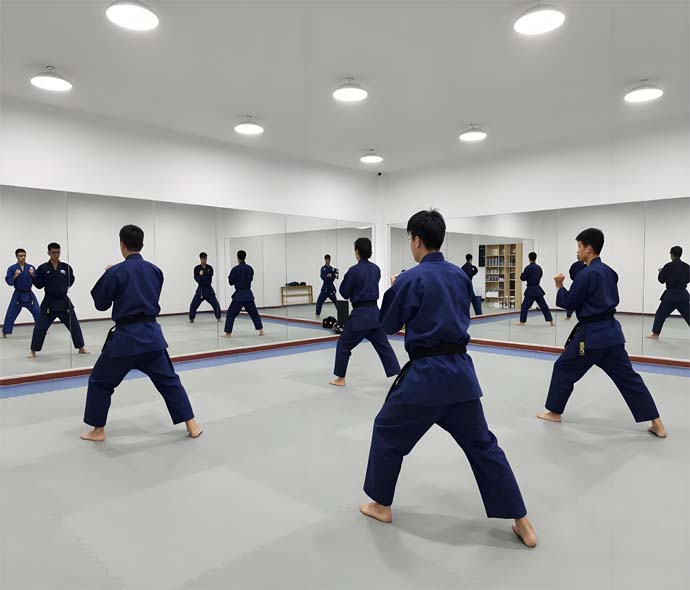
Karate training is organized around kihon (basics), kata (forms) and kumite (sparring). That means a lot of stances, pivots, kicks and footwork, and relatively few throws or ground impacts. A karate floor has to deliver five things:
Traction that grips bare feet without grabbing, so they can still pivot when they need to.
Cushioning that helps reduce impact through repeated kicks, drops and landings.
Stability underfoot. A surface that is too soft or too thick makes stances feel unsteady.
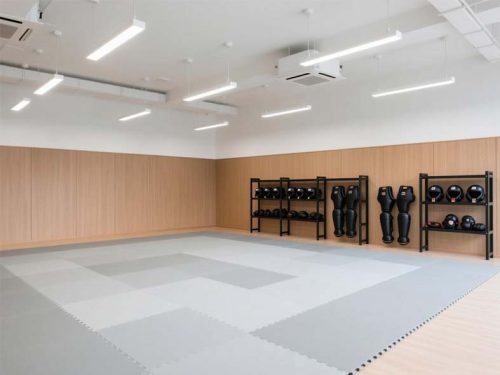
A defined, consistent training area, with no gaps or raised edges to catch a foot.
Floor protection and easy cleaning. The mat keeps feet and knees off concrete, tile or timber and shields the subfloor, and a barefoot shared room needs a surface you can wipe down daily.
This is why karate mats are generally thinner than judo or BJJ mats. A judo or BJJ floor has to absorb falls and body-weight impacts again and again. A karate floor spends most of its time under standing practitioners, so stability matters at least as much as depth of cushioning. This is general training logic, not a safety guarantee. Whether a floor is right depends on your actual mix of drills.
Competition Kumite: What Changes on the Floor
For WKF events, confirm the current competition-area layout, safety perimeter, mat approval and surface requirements with the organizer before purchasing. Training-mat specifications alone do not establish event eligibility.
Crosste supplies interlocking EVA mats for dojo and club training. For an official event, share the organizer’s mat and layout requirements so our team can review available specifications and supporting documents.
Types of Karate Mats
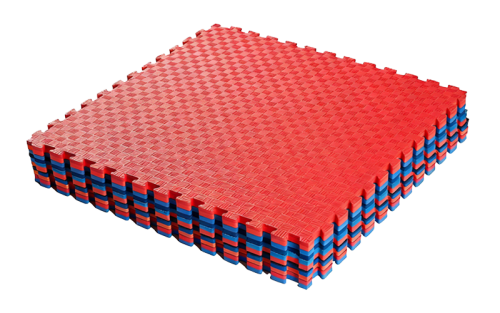
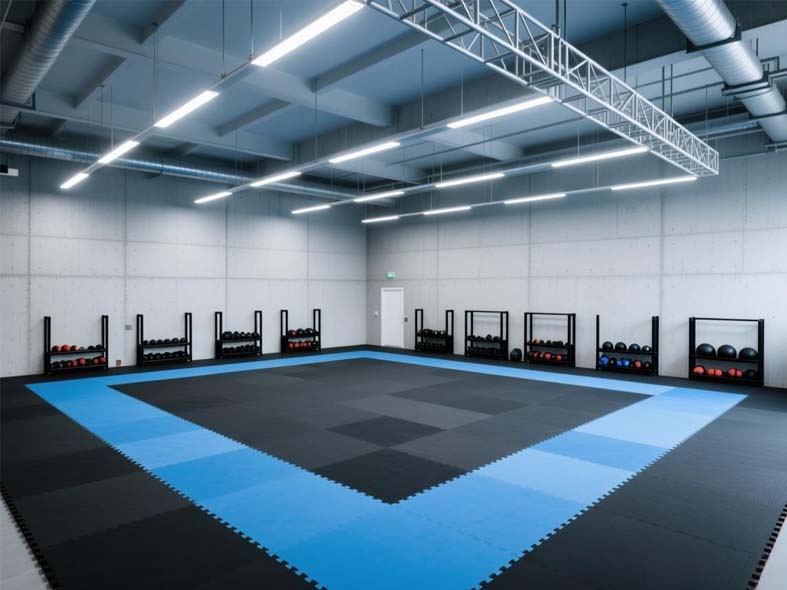
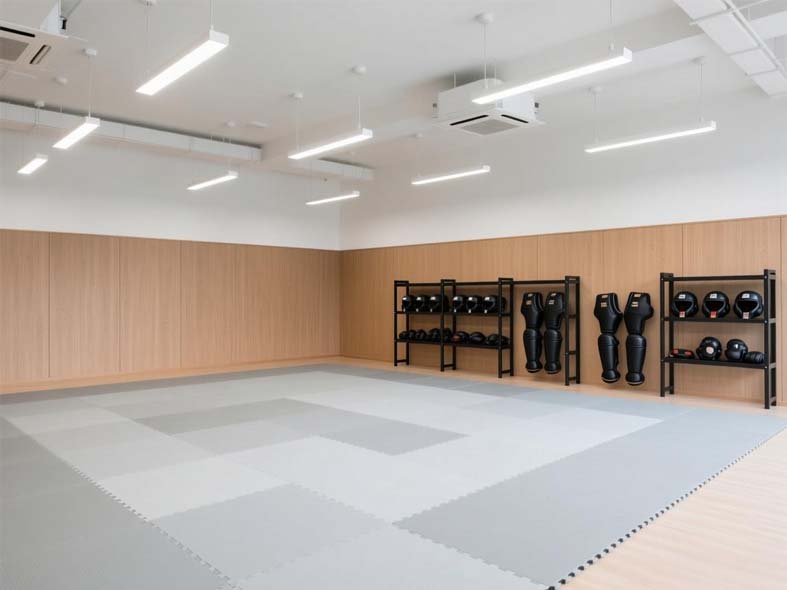
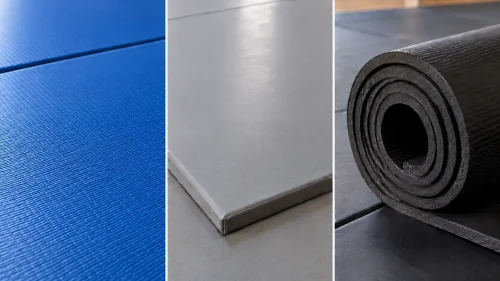
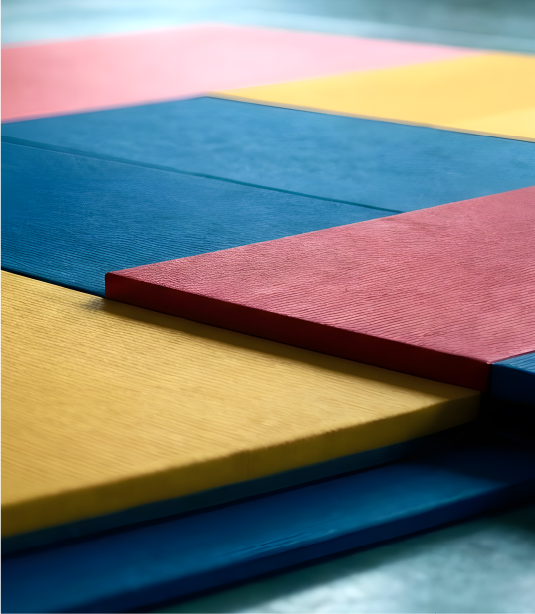
Interlocking EVA foam tiles (puzzle mats)
Interlocking EVA tiles are easy to install and can be replaced individually if damaged. For high-traffic rooms, confirm tile thickness, density, surface, edges and maintenance requirements before ordering. Crosste's EVA karate mats for dojo training are made in 100 × 100 cm and 50 × 50 cm sizes. Best for: dojo and club floors of all sizes, and home training areas.
Roll-out mats
Roll-out mats are large PVC-and-foam sheets with few joins. They are more typical in MMA and BJJ gyms, where the floor takes ground work, but they can suit a large, open dojo floor shared with other classes. The cost is losing the easy tile-by-tile replacement that EVA tiles offer. Best for: big, multi-purpose rooms where one continuous surface matters.
Smooth vs tatami-textured surfaces
Surface texture is a practical decision. A textured, tatami-style surface adds grip and a traditional look, and it can hide light scuffing. A smooth surface is generally quicker to wipe down and has a different feel underfoot. Ask the supplier which finishes are available for the specific model you want, because not every product comes in every texture.
How to Read a Karate Mat Spec: Thickness, Density and Size
Three numbers decide how a mat behaves: thickness, density, tile size. Surface is a separate choice that changes grip and cleaning, not cushioning. Understanding all four lets you compare quotes on equal terms.
Spec
What it changes
Typical karate consideration
Thickness (2, 2.5, 3, 4 or 5 cm)
Cushioning depth and how stable stances feel
Thickness: 2, 2.5, 3, 4 or 5 cm (subject to current production confirmation). Select by training activity and the intended floor build-up, rather than thickness alone.
Density (by thickness)
Available combinations, not hardness
Density availability: 2, 2.5 and 3 cm — 80, 100 or 120 kg/m³; 4 and 5 cm — 80 kg/m³ only. Density is not a direct measurement of hardness or impact attenuation.
Tile size (100 × 100 cm or 50 × 50 cm)
Number of seams, shipping and fit
Larger tiles cover big floors faster; smaller tiles suit odd shapes and easy storage
Surface (separate choice: smooth or textured)
Grip, cleaning and feel
Choose based on your cleaning routine and the grip you want
How thick should martial arts mats be?
Crosste karate EVA mats are available in 2, 2.5, 3, 4 and 5 cm thicknesses. Confirm suitable thickness through the intended activity, user group, subfloor and available performance data.
2–3 cm options are often considered for standing karate drills such as kata and footwork; suitability should be checked against floor conditions and training intensity.
2–3 cm: kata, kihon and kumite. The foam compresses little under a standing stance, so ankles stay stable through pivots, and there is still enough give to ease jumping kicks and landings.
4–5 cm models are available at 80 kg/m³ only. Where repeated throws or falls are planned, evaluate impact performance and consider a mat system designed and tested for that use.
These are rules of thumb, not safety ratings. Many karate-only dojos settle at the 2–3 cm end, and clubs that add partner drills or throws step up.
Density measures foam mass per unit volume (kg/m³), not hardness. For 2–3 cm mats, available densities are 80, 100 and 120 kg/m³; 4–5 cm mats are available at 80 kg/m³. Ask for the relevant hardness or compression test results when those properties matter.
Tile size
100 × 100 cm tiles reduce the number of joints across large areas; 50 × 50 cm tiles can simplify fitting around irregular layouts. Confirm packed dimensions and shipment volume for the selected model.
Red flags in a weak karate mat brief or quote
Vague numbers are where mismatched floors start. Watch for:
Thickness stated as "standard" or "thick", or in inches only, with no figure in cm.
"High density" with no kg/m³ value. Without the number you cannot compare two quotes.
No tile size, or no total tile count. Ask whether edge pieces are included in the quantity.
No surface stated, smooth or textured.
Request the exact test report or declaration for the specified mat model, including the tested standard, scope, issue date and intended market. Do not assume a report for one model applies to another.
Claims like "tournament approved" or "injury-proof" with no document behind them.
Photos of one product paired with specs of another.
For an accurate factory quotation, send room dimensions, training activities, preferred tile size and thickness, required quantities, color/logo needs, edge-strip requirements, destination and target delivery schedule.
Choosing and Caring for a Karate Mat: Home Space vs Dojo
Work through these questions before you pick a spec:
Training mix. Is it only kata and kumite, or are there partner drills and falls too? The more impact, the more thickness and density matter.
Room dimensions and subfloor. Measure the space, and check the floor underneath is flat and dry. Concrete, timber and tile all behave differently.
Number of students. Busy dojo floors wear faster than a home setup, so a firmer grade may hold its shape longer.
Cleaning routine. Shared barefoot floors need a surface you can wipe daily.
Colors and branding. Custom colors and logos are possible if you want the floor to carry your dojo identity.
For commercial dojo projects, provide a floor plan and expected daily use. Crosste can review the tile layout, specification options, edge pieces, branding needs and packing plan before quoting.
Caring for karate mats
Routine care is simple. Sweep or vacuum loose dirt, wipe with a mild cleaner, let the surface dry fully, and avoid harsh solvents that can damage the surface or edges. Store spare tiles flat so they do not warp. Always follow the supplier's care instructions for your specific model. For a step-by-step method, see how to clean martial arts mats safely.
Karate Mats FAQ
What is the point of tatami mats?
Tatami mats give a firm, grippy, clearly defined surface for barefoot practice. Traditional tatami is woven rush straw over a dense core. Modern tatami-style training mats are foam or PVC with a similar look and texture, so they add traction and cushioning while marking out the training area and protecting the floor beneath.
What is a karate mat called?
There is no single official name. "Tatami" is the traditional name and surface look, "karate mat" describes the function, and "puzzle mat" or "interlocking tile" describes the most common format. In product terms, the standard karate floor is an EVA foam mat, named after the material and sold as EVA foam tiles.
How thick should martial arts mats be?
Match it to what you train. For kata, kihon and kumite, 2–3 cm keeps stances stable. For classes with throws or regular falls, 4 cm or more gives extra cushioning. 1–2 cm suits light use and children. Crosste's EVA karate mats come in 1 to 5 cm, while judo and BJJ floors generally go thicker.
What density should karate mats be?
Available densities depend on thickness: 2, 2.5 and 3 cm can be specified at 80, 100 or 120 kg/m³; 4 and 5 cm are available at 80 kg/m³ only. Evaluate sample firmness and compression performance separately from density.
What size are karate mats?
EVA karate tiles commonly come in 100 × 100 cm and 50 × 50 cm, and Crosste makes both. The larger tile covers a floor quickly with fewer seams. The smaller tile is easier to ship, store and fit around irregular rooms. Custom sizes can be produced for specific projects.
How many karate mat tiles do I need for my room?
A 6 × 8 m rectangular area is 48 m²: theoretically 48 tiles at 100 × 100 cm or 192 tiles at 50 × 50 cm. Final quantities may change with room geometry, cuts, borders and installation waste; send a layout for a checked count.
Where can I find puzzle mats for martial arts?
Interlocking EVA tiles, often called puzzle mats, are sold by sports flooring retailers and by manufacturers. Retailers usually stock fixed sizes, while a manufacturer can produce custom size, thickness, density and color. Before ordering, confirm the thickness in cm, the density in kg/m³, the tile size, and whether edge pieces are included in the tile count.
Can I use tatami mats or puzzle mats for karate at home?
If training includes falls or throws, do not select on thickness alone. Check the mat’s intended use and available impact-performance data before choosing a floor system.
Are karate mats the same as judo mats?
No. Karate mats are usually EVA foam tiles that are thinner and softer, built for stances, kata and sparring. Judo tatami is firmer and denser, built for repeated throws. Crosste's judo tatami uses 190–270 kg/m³ cores, against 80–120 kg/m³ for its karate EVA range, so they suit different training.
Can karate mats be made in custom sizes and colors?
Custom colors, artwork and packaging can be discussed for production orders. Available logo methods, color tolerances, size and density combinations are confirmed for the selected model before sampling.
What should I provide for a bulk karate mat quotation?
Share your floor area, preferred mat thickness and size, expected quantity, colors or logo, edge-strip needs and delivery destination. We will review feasible options and prepare a project-specific quote.

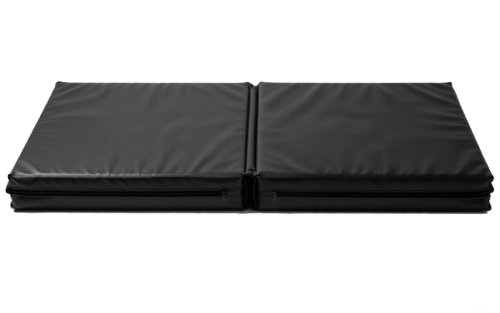
 Home Use Roll Up Wrestling Mat for Training and Practice
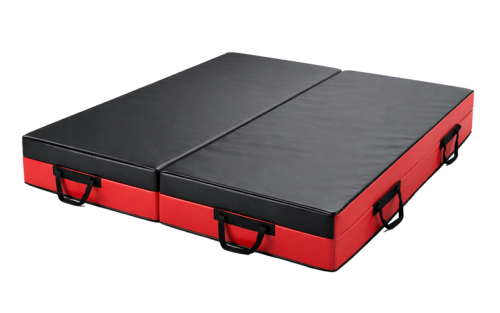
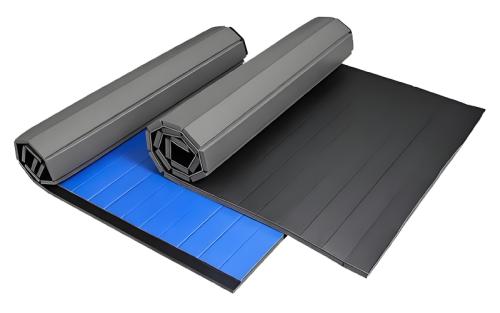 Custom MMA Mats
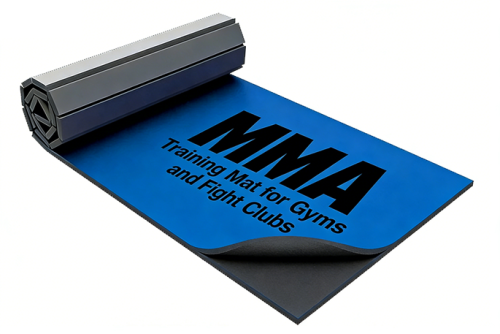 BJJ Mats Durable Training Mats for Martial Arts Gyms
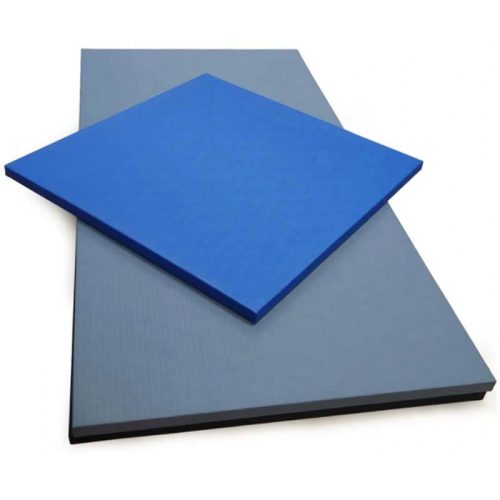 Judo Tatami Custom Size Mats for Academy and Competition
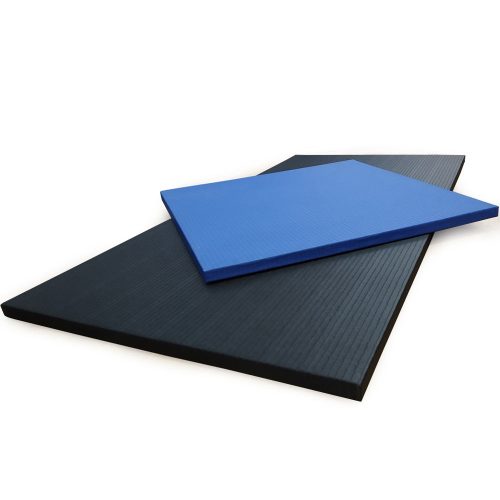 Judo Flooring Customizable Mats for Schools and Academies
 Judo Mat Durable Training Mat for Dojos and Clubs
 Wood Grain EVA Taekwondo mat Durable Anti Slip Flooring for Dojos
 Wrestling Mat Durable Surface for Training and Competition