5 Costly Mistakes Gym Owners Make When Ordering Custom Wrestling Mats
The five mistakes that cost gym owners the most when ordering custom wrestling mats are: choosing the wrong thickness for their athlete profile, ignoring foam density, miscalculating mat size against room and competition specs, accepting cheap vinyl that fails within a year, and skipping supplier verification on manufacturing and freight. Each of these can quietly add 20–40% to your true cost of ownership over five years. Below, we break down exactly what to watch for — and what to ask your supplier before you sign anything.
Mistake #1: Picking Thickness Based on Price, Not Use Case
Thickness is where most bad orders start. A buyer sees a 1.25-inch mat priced 18% cheaper than the 1.5-inch option and assumes the savings are free money. They're not.
Wrestling mats typically come in 1.25" (30mm), 1.5" (40mm), and 2" (50mm). The right choice depends on who's actually training on it. High school folkstyle programs and youth clubs can usually live with 1.25". Collegiate rooms, freestyle clubs with heavy throws, or any facility that doubles as MMA or judo space should be on 1.5" minimum — and 2" if you're running consistent suplex drilling.
A quick real-world example
A Midwest high school we worked with ordered 1.25" mats to save roughly $1,400 on a 42x42 ft layout. Within 18 months, their head coach was complaining about athlete hip and shoulder bruising during live takedowns, and they ended up adding crash pads on top — spending more than the upgrade would have cost in the first place. Spec your thickness for the heaviest, most aggressive training you'll do, not the average session.
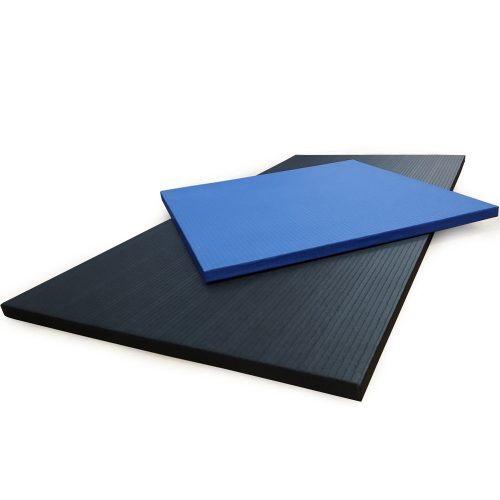
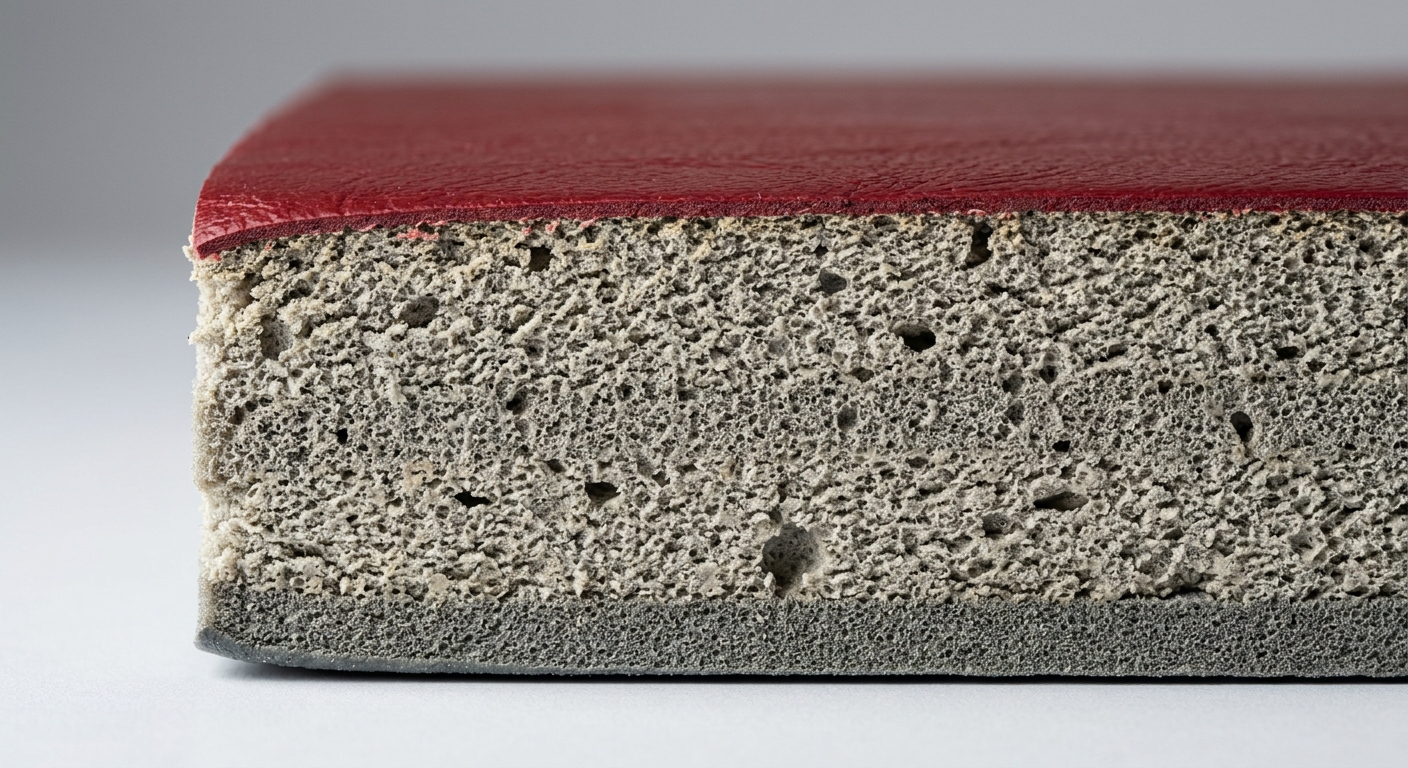
Inside a Cheap Wrestling Mat: Thin Foam, Higher Injury Risk
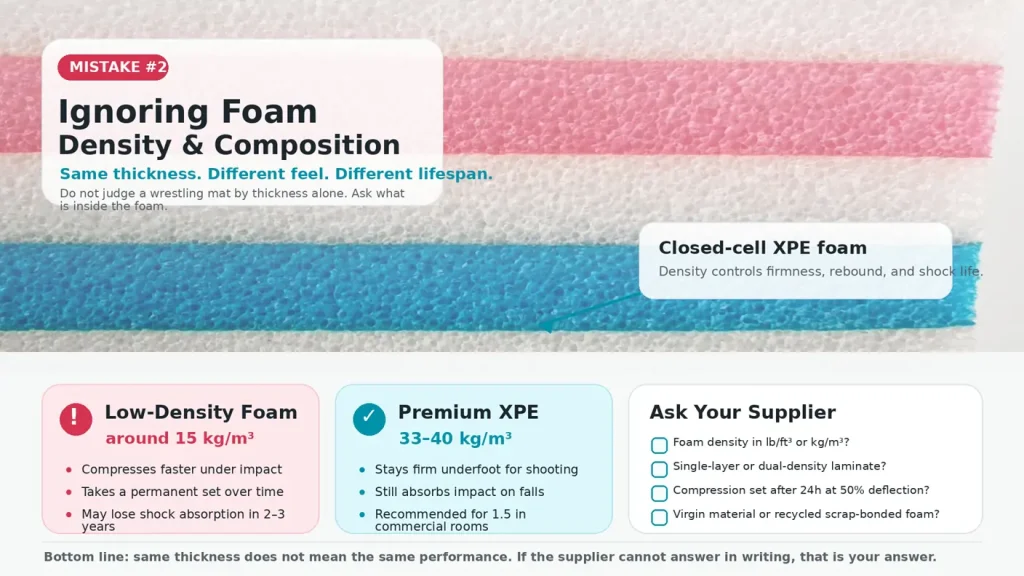
Mistake #2: Ignoring Foam Density and Composition
Two mats can be the same thickness and feel completely different underfoot. The reason is foam density — and most buyers never ask about it.
Wrestling mats use closed-cell cross-linked polyethylene (XPE) foam, but density varies from about 15 kg/cbm on the cheap end to 33-40 kg/cbm on premium rolls. Low-density foam compresses faster, takes a permanent set under repeated impact, and loses shock absorption within 2–3 years. High-density foam stays firm under the feet for shooting, while still absorbing impact on falls.
What to ask your supplier
What is the foam density in lb/ft³ or kg/m³?
Is it single-layer or a dual-density laminate?
What is the compression set rating after 24 hours at 50% deflection?
Is the foam virgin material or recycled scrap-bonded?
If your supplier can't answer these in writing, that's your answer. For commercial wrestling rooms, we recommend 33-40kg/cbm XPE for 1.5" mats. You can see the foam specs we manufacture to on our products page.
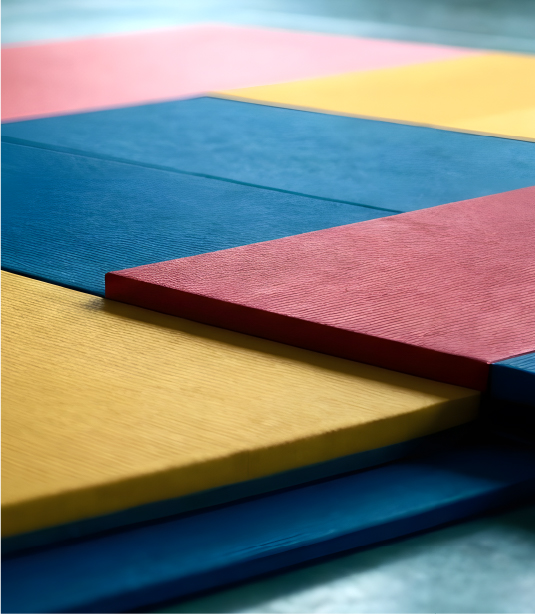
Macro texture of dense closed-cell wrestling mat foam
Mistake #3: Miscalculating Mat Size Against Room and Competition Specs
Here's a costly one: ordering a mat that doesn't actually fit your competition needs or your room. We see this monthly.
Official NFHS high school wrestling mats require a minimum 28-foot diameter circle with a 5-foot safety border — meaning your mat needs to be at least 38x38 ft. NCAA and UWW freestyle/Greco specs call for a 9-meter (29.5 ft) circle inside a 12x12 m mat. A youth club room sized for two 28-ft circles on one mat needs roughly 42x84 ft of usable surface.
The room measurement trap
Measure the usable floor — not the wall-to-wall dimension. Subtract clearance for wall padding (typically 2"), any columns, and at least 18" of walkway clearance from doors. A gym that ordered a 42x42 ft mat for a room measured 42x42 wall-to-wall ended up trimming the mat on site after wall padding ate 4 inches per side. Trimming a custom wrestling mat voids most warranties and ruins the vinyl edge seal.
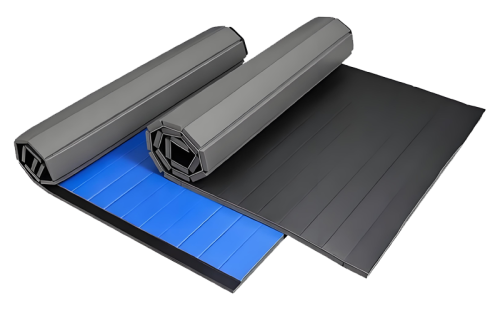
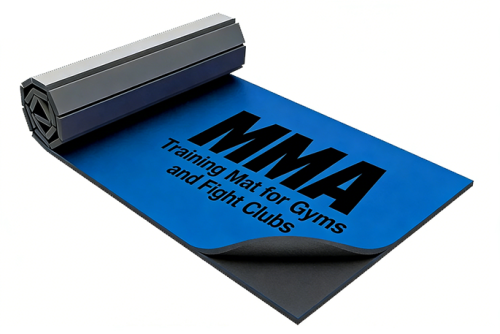
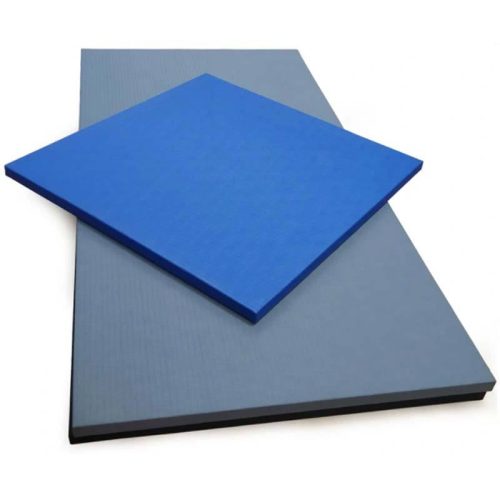
For multi-use rooms — wrestling plus BJJ plus MMA conditioning — consider modular tiles or roll-out mats instead of one giant sheet. Our facility solutions team regularly designs hybrid layouts for combat sports gyms running 3+ disciplines.
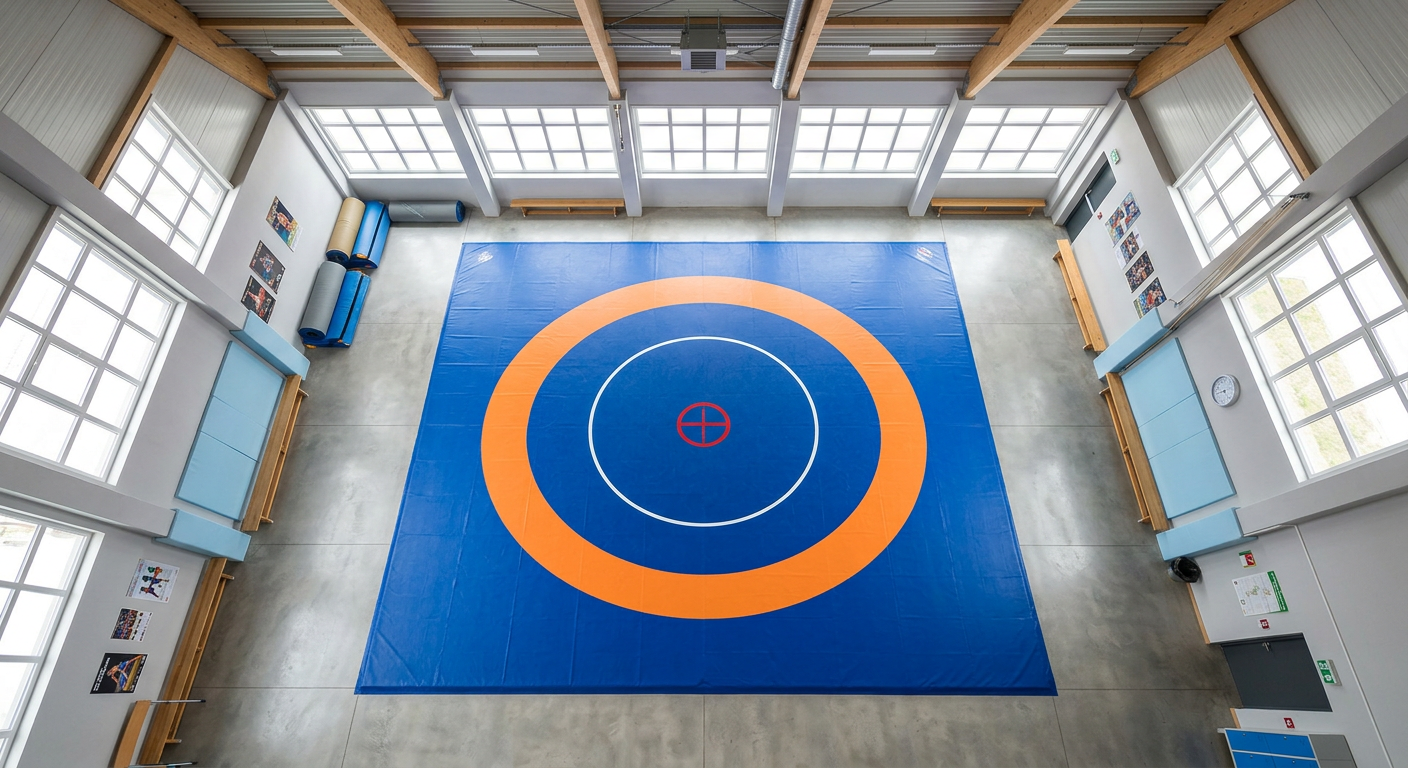
Overhead view of wrestling competition mat in a training room
Mistake #4: Accepting Whatever Vinyl Comes Standard
The foam might be the heart of a wrestling mat, but the vinyl skin is what fails first. And almost nobody asks about it.
Look for these specs:
Anti-microbial / anti-fungal treatment: Non-negotiable. Wrestling rooms breed staph, ringworm, and herpes gladiatorum. Demand a treated top layer with documented test results.
Surface texture: A pebble or matte finish gives the right balance of grip and slide. Too smooth and athletes slip on takedowns; too aggressive and you get mat burn.
Seam construction: RF-welded (radio-frequency welded) seams last 3–5x longer than glued seams.
Real example
A wrestling academy bought discounted mats with glued seams. By month 14, three seams had split, the surface had two visible tear repairs, and ringworm outbreaks spiked because the porous patches couldn't be properly disinfected. Replacement cost: full mat, year two. The “cheap” mat cost double a proper one.
Mistake #5: Skipping Supplier Verification on Manufacturing and Freight
The cheapest quote almost always hides something. Usually it's manufacturing capability or freight liability.
Before you order, verify:
Are they actually the manufacturer? Many “suppliers” are middlemen with no production control. Ask for a factory video tour or third-party audit.
Material certificates: SGS, REACH, or CPSIA reports for foam and vinyl.
Production lead time vs. shipping time: 25–40 days production plus 30–45 days ocean freight is normal for overseas bulk orders.
Freight terms: FOB, CIF, or DDP — and who handles customs clearance and last-mile delivery? A pallet of 42x42 ft wrestling mat weighs 1,800+ lbs. Curbside drop-off without a lift gate has stranded more than one gym owner.
Damage protection: Vinyl gets scuffed during ocean transit if rolled and crated incorrectly. Confirm the rolling and crating method in writing.
OEM and custom logo orders
If you want your gym name or sponsor logo printed on the mat, get the artwork approval and color-matching process documented before deposit. Pantone matching adds 5–10 business days but prevents the dreaded “the red looks orange” phone call. Our OEM & ODM service covers logo placement, multi-color printing, and pre-production sample approval.
Sports mat manufacturing facility with rolled materials and crating area
Bonus: The Maintenance Mistake That Kills Mat Warranties
This one isn't an ordering mistake — it's what happens after. But it costs gym owners thousands, so it earns a spot.
Most warranties exclude damage from improper cleaning. Bleach, ammonia, and most industrial degreasers chemically degrade vinyl and break down the antimicrobial topcoat within months. Use a pH-neutral, hospital-grade disinfectant rated for vinyl (Kennedy Industries Mat Sanitizer, Rejuvenal, or equivalent). Dilute to manufacturer spec. Mop daily, deep-clean weekly.
Rolled and folded mats also need attention. Never store a roll-out wrestling mat folded for more than 30 days — permanent creases form in the foam. Roll storage on a wall-mounted rack is the gold standard.
How to Run a Smart Wrestling Mat RFQ
If you're about to send out quote requests, structure your RFQ to force suppliers to compete on specs — not just price. Include:
Exact mat dimensions and quantity
Required thickness and foam density (kg/cbm)
Seam type (RF-welded required)
Logo or surface marking artwork files
Required certifications (SGS, REACH, ASTM F355 if applicable)
Delivery terms (DDP preferred for first-time importers)
If a supplier dodges any of these or replies with a vague “yes, all standard,” move on. Good manufacturers welcome detailed specs because it filters out price-only shoppers. For more on mat surface choices across combat sports, our breakdown of tatami vs. smooth surface judo mats covers similar trade-offs in adjacent disciplines.
Putting It All Together
A wrestling mat is a 7–10 year asset. The right specs cost 15–25% more upfront and save you thousands in early replacement, injuries, and skin infection outbreaks. Anchor your decision on foam density and vinyl weight first, dimensions second, and price third — never the other way around.
If you're sourcing custom wrestling mats for a new facility, an expansion, or a wholesale program, we'd be glad to put together a quote with full spec documentation, sample swatches, and freight options laid out clearly. Reach out to our team with your room dimensions and athlete profile, and we'll send back a recommendation built around how your gym actually trains.

 Home Use Roll Up Wrestling Mat for Training and Practice