HomeBlogNewsTaekwondo Uniform vs Karate Gi: Key Differences Clubs Should Know Before Bulk Ordering
Taekwondo Uniform vs Karate Gi: Key Differences Clubs Should Know Before Bulk Ordering
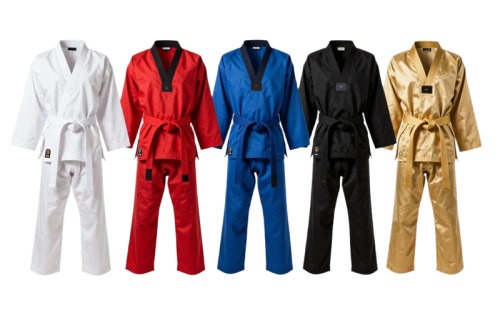
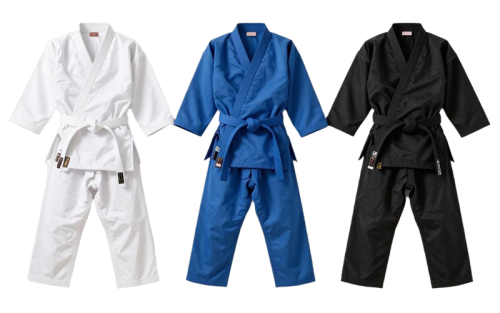
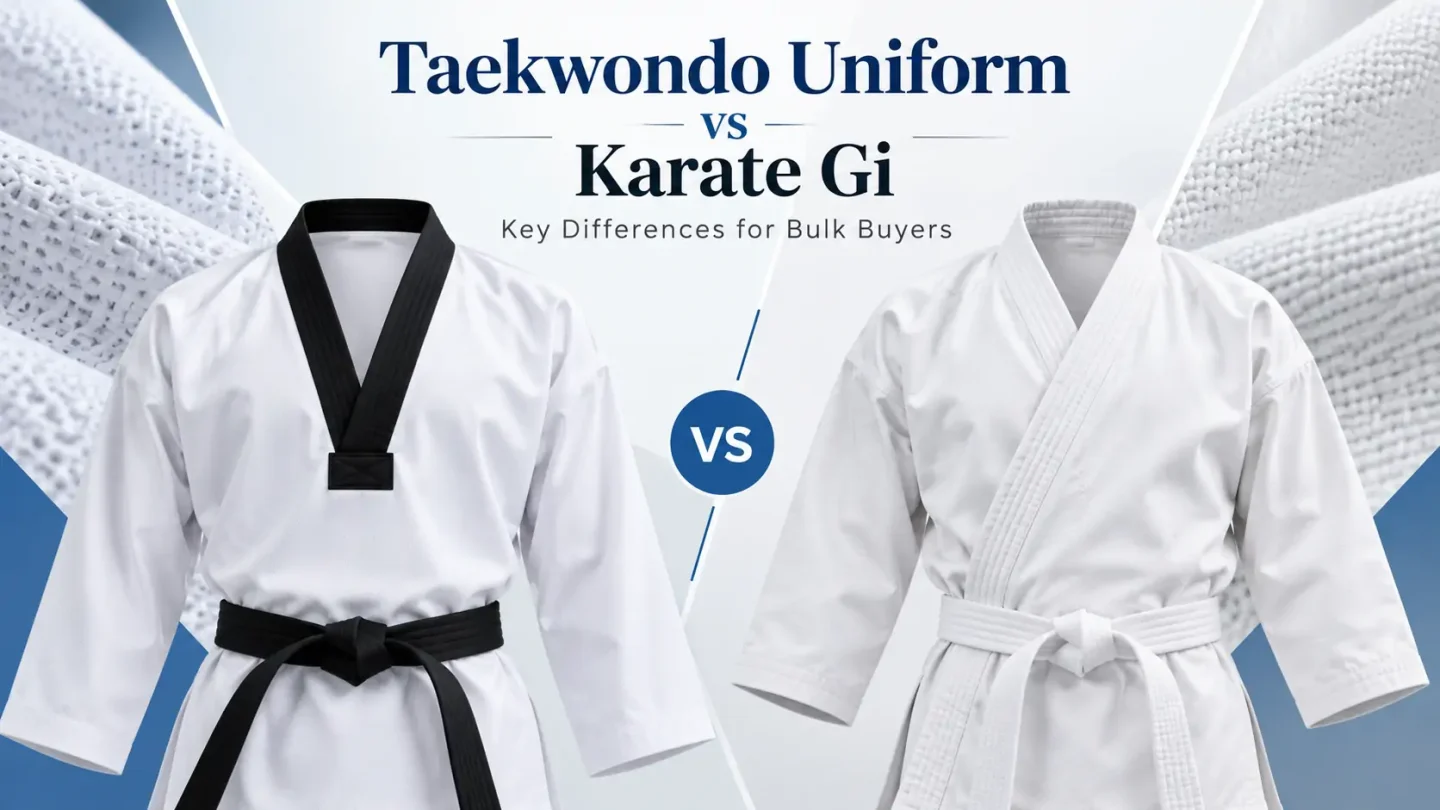
A typical WT-style taekwondo uniform (dobok) features a pullover V-neck top and lightweight fabric designed for flexibility and comfort, while a traditional karate gi uses a wraparound jacket with fabric weight varying by training or competition needs. For bulk buyers, the real differences that matter aren’t the ones beginner guides talk about. They’re fabric weight, closure durability under heavy washing, and how each design holds up to logo customization and daily training use.
Key takeaways
A taekwondo dobok uses a pullover V-neck top in lighter fabric for kicking speed, while a karate gi uses a wraparound tie-front jacket in heavier cotton for strike and grip resistance.
Fabric weight and weave type, not just cut, determine durability under daily washing: cotton-heavy gi fabric shrinks more than poly-cotton dobok blends.
Cost per student across a full season matters more than unit price; a cheaper uniform that needs mid-season replacement often costs more once reorder and shipping overhead are counted.
Cross-discipline uniform use works only for casual mixed classes; serious training in judo, BJJ, karate, or taekwondo needs discipline-specific construction.
Request fabric GSM specs and samples before comparing supplier quotes, since unit price alone doesn’t reveal durability or branding compatibility.
Dobok vs Gi: The Structural Difference That Actually Matters
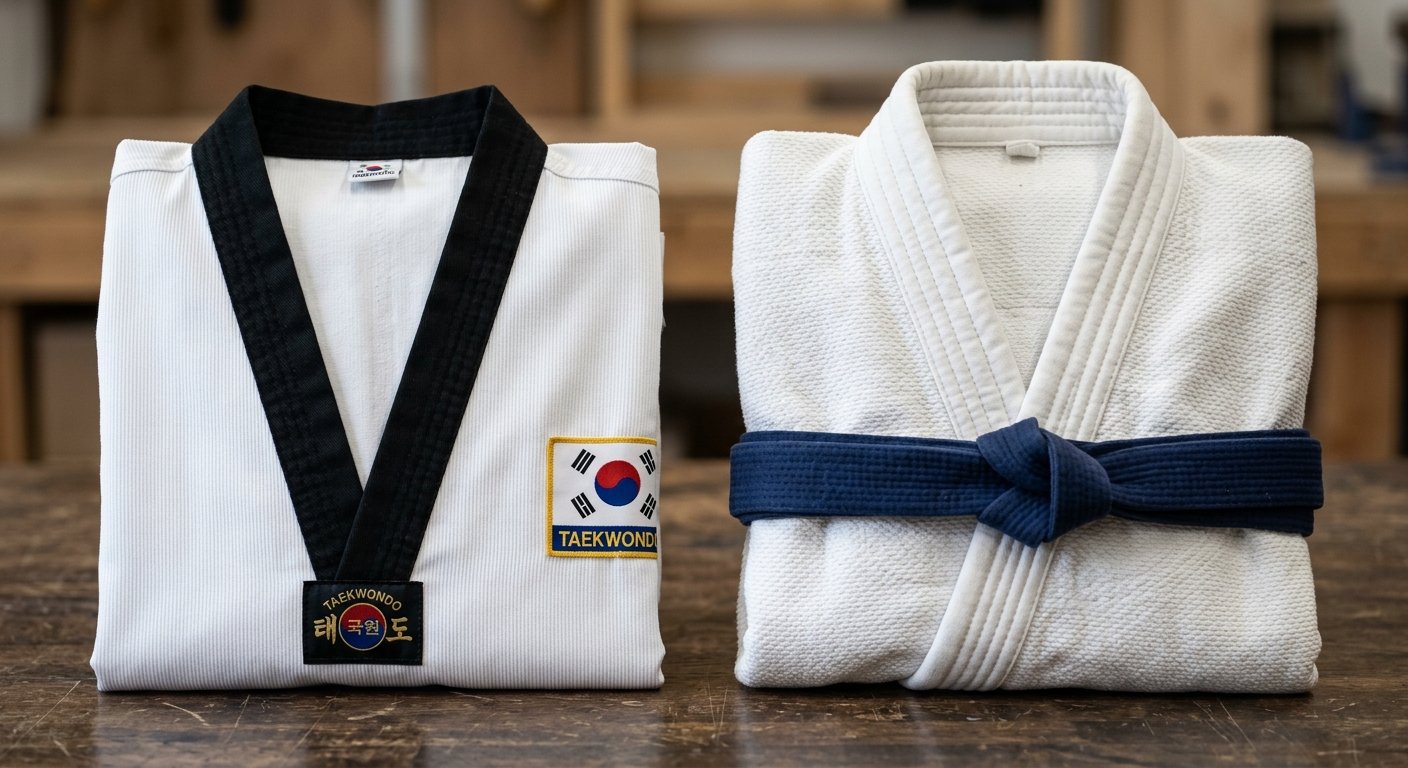
Pull one on and you’ll feel it instantly: a taekwondo dobok slips over the head like a loose t-shirt, closed with a short V-neck opening and maybe a snap or velcro tab. A karate gi, on the other hand, wraps across the body like a robe and ties shut with a belt that holds the overlapping panels in place. That’s not a style choice. It’s an engineering decision tied directly to how each art moves.
Taekwondo is a kicking art built around speed, height, and rotation. The pullover design helps keep the top securely in place during dynamic kicking movements. The pullover dobok sits close to the torso and stays put through spinning and jumping kicks. Karate, by contrast, leans on striking combinations and stance-based kata where a wraparound jacket needs to stay closed under contact and grabbing. The overlapping jacket design provides a traditional fit, with closures and a belt helping keep the uniform in place during training.
Collar color matters for bulk orders
One detail that first-time bulk buyers should confirm is collar color. Depending on the organization and competition rules, WT-style doboks may feature white collars for color-belt students, black collars for Dan grades, and black-and-red collars for eligible Poom grades. If you’re ordering for a whole school, you need a breakdown by belt rank before you place the order, not after the uniforms arrive.
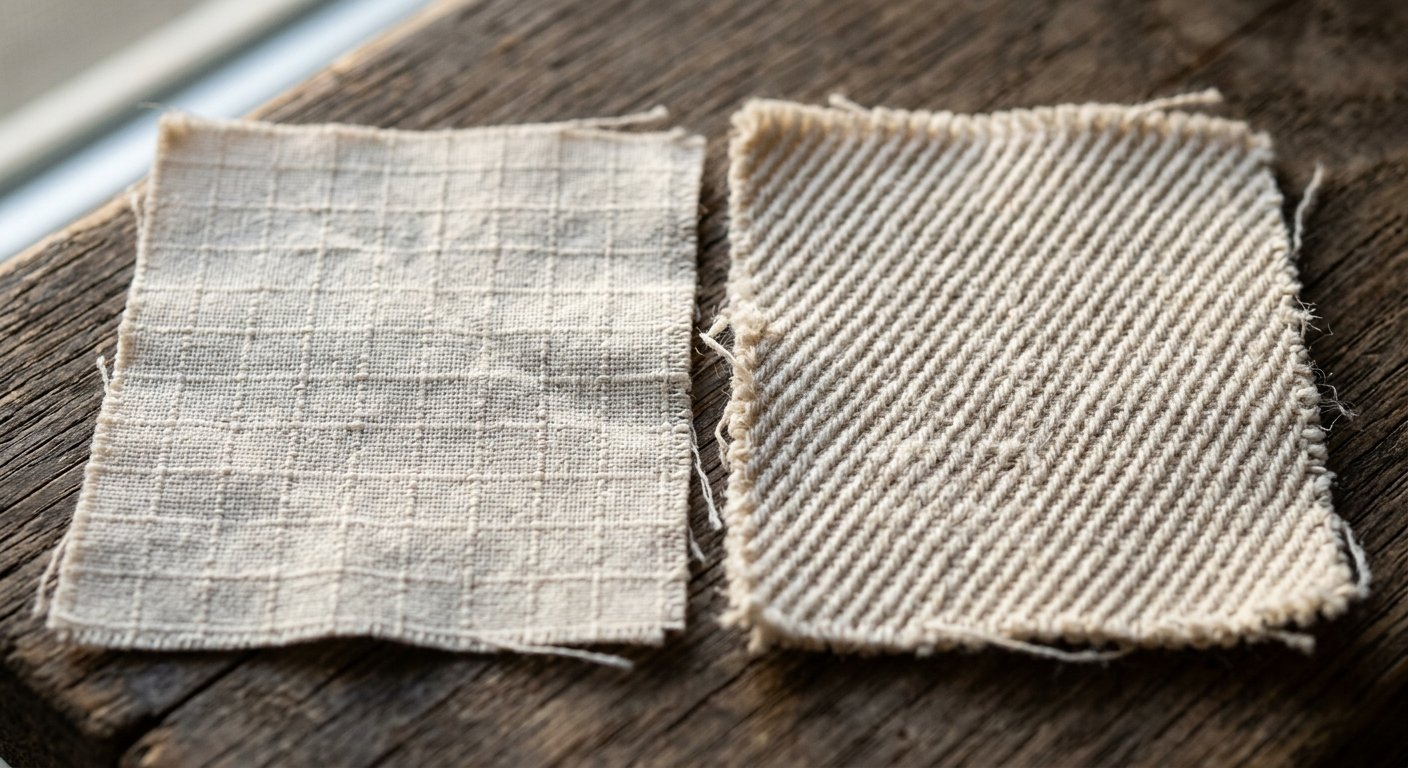
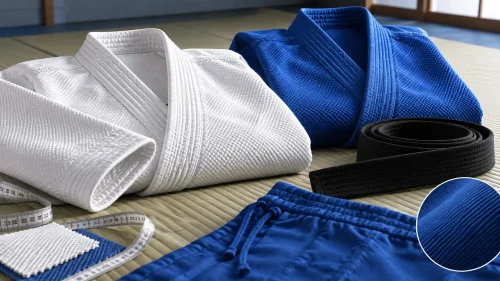
Close-up of pullover V-neck collar next to wraparound tied jacket collar on martial arts uniformsMacro shot comparing lightweight ripstop fabric and heavy twill fabric weaves
Is Karate Uniform and Taekwondo Uniform the Same? The Fabric Tells the Real Story.
No, they are not the same garment, and the proof is in the fabric spec sheet, not just the cut. A karate gi built for kata typically uses a heavier, denser weave than a taekwondo dobok, and that weight difference changes how the uniform moves, sounds, and wears.
Dobok fabric generally runs lighter, often a ripstop or poly-cotton blend chosen for airflow and reduced drag during fast kicking. Kata-style karate gi often uses heavier, structured cotton fabric, while kumite uniforms are typically lighter and designed for greater freedom of movement.. That’s also where the famous “snap” sound comes from: a heavier, stiffer weave cracks audibly on a sharp strike, which practitioners use as real-time feedback on technique. A lightweight dobok fabric won’t produce that sound, because it isn’t designed to.
Attribute
Taekwondo Dobok
Karate Gi
Relative fabric weight
Generally lightweight
Varies by kata, kumite, or training use
Weave / Material
Often polyester or poly-cotton blends
Cotton, poly-cotton, or other performance fabrics
Audible “snap” on strike
Usually minimal
More noticeable in heavyweight kata gi
Primary design priority
Speed, airflow
Structure, impact resistance
Heavier isn’t automatically better here. Heavier fabrics can provide a more structured feel, while lighter fabrics generally offer greater comfort and freedom of movement during dynamic training. For a deeper breakdown of GSM ranges and weave options across martial arts apparel, see our martial arts uniform fabric guide.
Which Holds Up Better Under a Full Training Season? Durability and Washing
Neither uniform type is immune to wear, but they fail in different places and for different reasons. Knowing which failure point to expect lets a buyer plan replacement cycles instead of reacting to complaints mid-season.
Cotton-heavy karate gi fabric shrinks more aggressively than the poly-cotton blends common in taekwondo dobok, especially under hot-water washing that most dojos and dojangs end up using once sweat and grime build up daily. That shrinkage shows up first at the sleeve and pant hems, which is where a club starts fielding “my uniform doesn’t fit anymore” complaints halfway through a term.
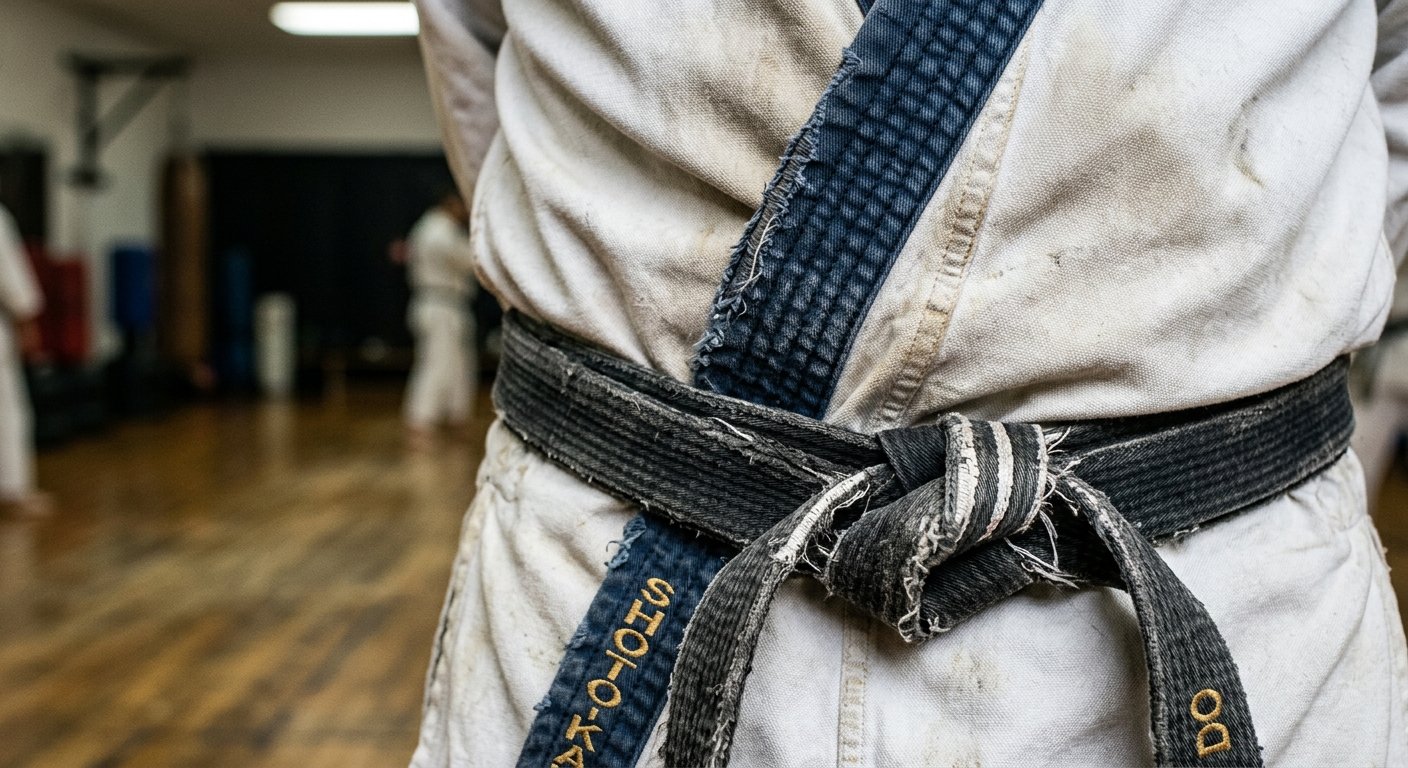
Wash frequency is the real driver of visible wear in a school setting. Daily or near-daily training means near-daily washing, and that accelerates fading at high-friction points: the collar, cuffs, and belt line. Tie-front gi closures also wear differently than pullover collars. The friction point on a gi concentrates at the belt knot and the overlapping panel edge, while a dobok’s wear concentrates at the collar seam and underarm stitching.
Rather than budgeting replacement on a fixed timeframe, watch for the real signals: fabric thinning at stress points, seam separation, and collar fraying. Those tell you a uniform is near the end of its useful life regardless of how many months it’s been in rotation.
Worn martial arts uniform collar showing fabric wear and fading from repeated washing
Cost-Per-Student Economics: Cheap Uniforms vs Premium Stock for a Full Season
Unit price is the wrong number to anchor a bulk order on. The number that actually matters is cost per student across the full season, and that depends on how many times you reorder, not how cheap the first invoice looked.
Take a hypothetical dojang ordering 60 uniforms for a new intake. A cheaper fabric that thins out or shrinks noticeably by mid-season forces a second order, which means a second shipping charge, a second round of sizing coordination, and staff time spent chasing measurements again. A single durable order, even at a higher per-unit price, often ends up cheaper once you count the admin overhead of a reorder.
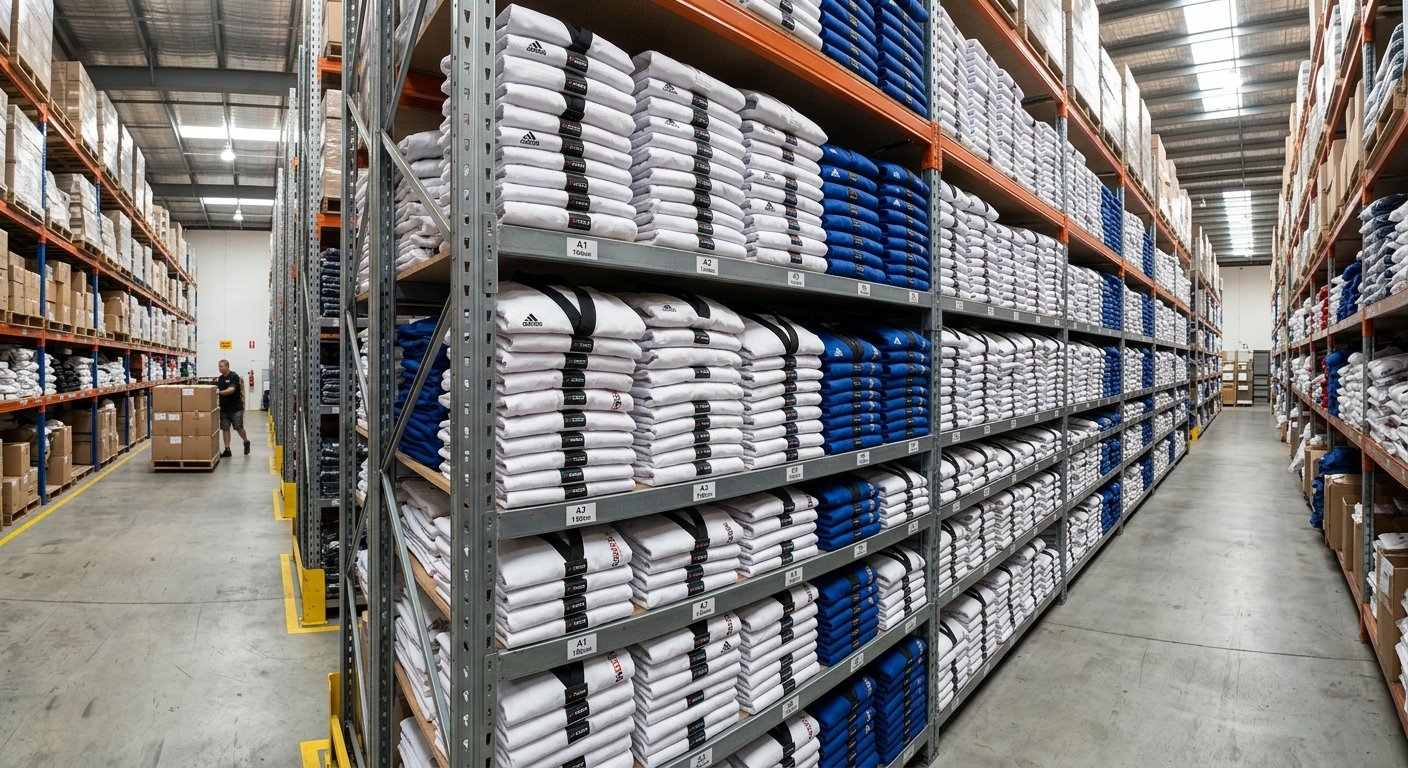
Bulk, standardized sizing also lowers per-unit cost compared to ordering individual pieces ad hoc as new students enroll throughout the year. Placing one consolidated order instead of several small ones cuts down on repeated paperwork, repeated sizing coordination, and repeated shipping charges, which is where a lot of the hidden cost in ad-hoc ordering actually comes from.
Fabric weight should match how often the uniform gets used. A once-a-week kids’ class can run comfortably on lighter, lower-cost fabric since wash frequency and wear are both low. A daily competitive dojang needs heavier-duty stock that can survive constant washing without shrinking out of size. Before comparing quoted prices across suppliers, ask for the fabric GSM spec on each option. Unit price alone, without a GSM number attached, tells you almost nothing about what you’re actually buying.
Stacked folded martial arts uniforms organized on warehouse shelving for bulk order fulfillment
Can One Uniform Work Across Taekwondo, Karate, Judo, and BJJ?
Technically you can put a student in any gi for any class, but it’s a compromise in every direction, not a shortcut. A judo or BJJ gi is built with reinforced, grip-resistant weave designed to survive constant grabbing and pulling. That reinforcement adds weight and stiffness that makes it clumsy and slow for taekwondo kicking drills.
Run it the other way and the problem flips. A lightweight taekwondo dobok has no reinforced collar or seam structure, so it tears quickly under judo-style grip training. The fabric simply wasn’t built to take that kind of stress.
So the honest answer: cross-use works for a casual mixed class where nobody’s pushing intensity, but it compromises performance and durability in either discipline the moment training gets serious. For any academy running multiple programs under one roof, the practical move is stocking separate uniform types rather than chasing a single “universal” option. Crosste’s apparel range covers this directly, offering martial arts apparel including Judo Gi, Taekwondo Uniforms, Karate Gi, and BJJ Gi as distinct product lines rather than one compromise garment.
Sizing, Logo Branding, and Bulk Ordering for Schools and Distributors
Outfitting a full class is a different problem than outfitting one practitioner, and most of the friction in a bulk order shows up in these details:
Age/height-based sizing charts: Build your order around a sizing chart rather than individual measurements collected one by one, especially for children’s classes where sizes shift fast.
Branding method options: Embroidery, screen printing, heat transfer, woven labels, and sewn-on patches are common options for adding a school logo or team mark to a uniform.
Durability of branding under wash: A patch is a separate piece of material stitched or heat-pressed onto the fabric, while printed branding is ink sitting on the surface. That structural difference is why patches generally hold their look longer under repeated heavy washing, while printed logos are more exposed to fading and cracking over time. Ask your supplier which method fits your wash frequency before committing to a branding choice.
Color matching for belt rank or school identity: Pantone color matching lets schools lock in a consistent collar color or trim across every order, useful when belt rank colors need to stay identical year over year.
OEM/ODM workflow for distributors: A typical sourcing path runs through inquiry and requirements, proposal and quotation, sampling, mass production, then QC, packing, and shipping. Distributors placing recurring orders benefit from having this process mapped out before the first purchase order goes in.
For buyers planning a custom run, Crosste’s OEM & ODM program covers design, materials, branding, and mass production under one workflow.
Dobok vs Gi at a Glance: Side-by-Side Spec Comparison
The comparison below pulls together every spec covered above into one checklist you can take straight to a supplier quote.
Spec
Taekwondo Dobok
Karate Gi
Cut / Closure
Pullover V-neck
Wraparound tie-front
Durability under heavy wash
Depends on fabric composition and construction
Depends on fabric composition and construction
Best-use discipline
Taekwondo training, forms, and sparring
Karate training, kata, and kumite
Branding suitability
Collar/sleeve print or patch
Chest patch or heavier-cloth print
Use this table as a starting checklist when comparing supplier quotes. If a quote doesn’t let you check these boxes, ask for the missing spec before signing off on quantity and price.
Choosing and Ordering the Right Uniform Line for Your Club
Before placing a bulk order, run through this checklist: training frequency, discipline mix under your roof, budget per student, branding needs, and how often you expect to reorder. Each of those answers should push you toward a specific fabric weight and closure type, not a generic “best seller” listing.
Request fabric samples and GSM specs from any supplier before committing to quantity. A sample in hand tells you more in thirty seconds than a spec sheet does in an email thread.
CROSSTE supplies a wide range of martial arts uniforms, including Judo Gi, Taekwondo Uniforms, Karate Gi, and BJJ Gi, with OEM customization options for clubs, schools, and distributors worldwide. For schools and distributors outfitting multiple students across one or several disciplines, that range means sourcing separate uniform types from a single supplier rather than juggling vendors. Visit crosstemat’s product range or reach out through our contact page to request a quote or sample for your next bulk order.
Frequently asked questions
Is karate uniform and taekwondo uniform the same?
No. A taekwondo uniform (dobok) is a pullover V-neck top in lighter fabric built for kicking speed, while a karate gi is a wraparound tie-front jacket in heavier cotton built for striking and grip resistance. The fabric weight, weave, and closure differ enough that they aren’t interchangeable for serious training.
Which is more difficult, taekwondo or karate?
Difficulty depends on what a student finds hard: taekwondo demands flexibility, speed, and kicking precision, while karate emphasizes stance stability, striking power, and kata discipline. Neither is objectively harder; the technical demands are simply different, and uniform design in each art reflects that difference directly.
Should I put my kid in karate or taekwondo?
This is a personal and program-fit decision, not a uniform question, but it’s worth noting that taekwondo’s kicking-focused curriculum pairs with a lighter, freer-moving dobok, while karate’s striking and kata focus pairs with a heavier, structured gi. Visiting both classes in person is the best way to decide.

 Home Use Roll Up Wrestling Mat for Training and Practice
 Custom MMA Mats
 BJJ Mats Durable Training Mats for Martial Arts Gyms
 Judo Tatami Custom Size Mats for Academy and Competition
 Judo Flooring Customizable Mats for Schools and Academies
 Judo Mat Durable Training Mat for Dojos and Clubs
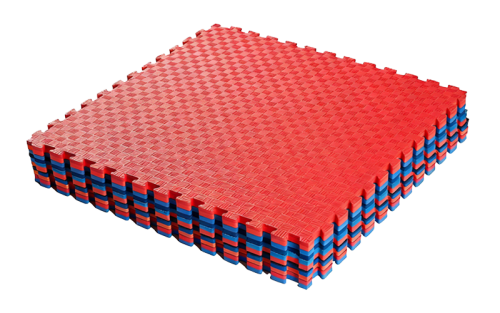 Karate Mats Impact Absorption for Dojo Training
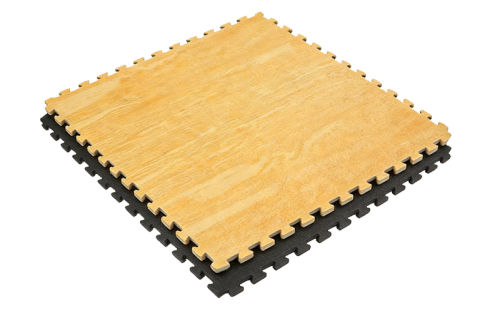 Wood Grain EVA Taekwondo mat Durable Anti Slip Flooring for Dojos